Is the real capacity picture still assembled by phone?
Admissions, wards and discharge may each hold a piece of the answer while management needs one operational context.
Sarop Hospital · Institutional platform
A connected hospital workspace for patient flow, capacity, operational coordination and continuity — designed to work around existing hospital systems, from arrival to discharge and beyond.
Institutional, organization-scoped and permission-aware. Pilot scope depends on configured integrations and verified workflows.
Placement context review
Transfer context pending
Discharge transition ready
Before another dashboard
Hospitals rarely lack systems or committed people. The management gap appears between them: when the current state, the next accountable action and the owner of that action cannot be seen together.
Admissions, wards and discharge may each hold a piece of the answer while management needs one operational context.
A transfer, readiness decision or pending task can lose time between systems, units and shifts.
When responsibility is implicit, work is rediscovered through calls, messages and manual follow-up.
The hospital event can close while the next questionnaire, follow-up or care handoff still has no visible owner.
Retrospective reporting explains what happened; operational teams also need to know what requires attention now.
A new operating layer should respect existing systems and data ownership instead of demanding a wholesale replacement.
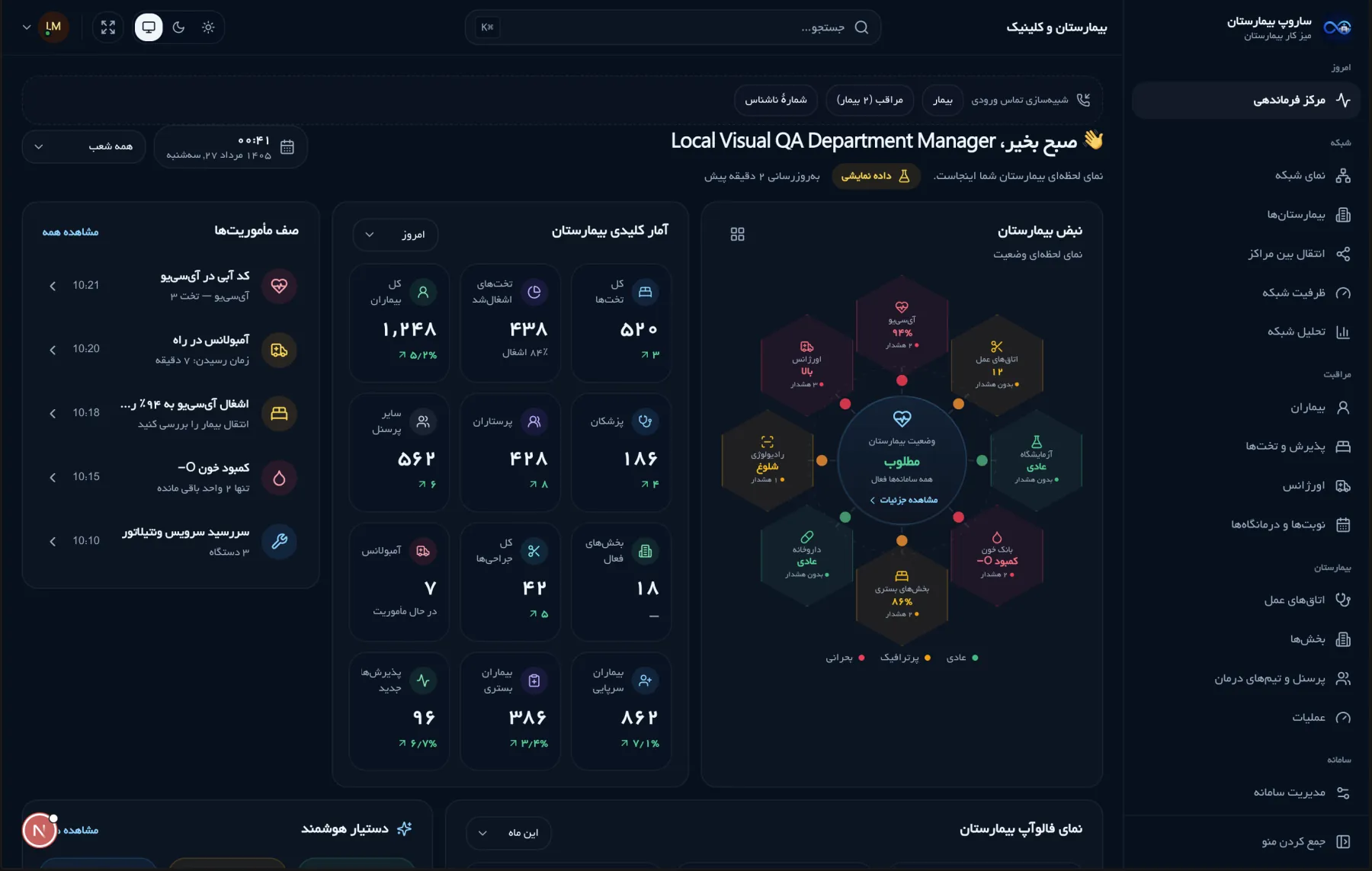
Product interface evidence
This approved Persian capture shows the current Command Center presentation environment. It demonstrates the interface and information hierarchy—not live telemetry, production readiness or measured hospital performance.
The operating idea
Sarop Hospital organizes the institutional view around the movement of care. Each stage remains bounded by role, organization, purpose and the systems that own the underlying record.
Admissions & capacity
Bring admissions, transfers, discharge state and aggregate capacity into an organization-scoped operational view. Sarop’s current contracts support admission lifecycle and aggregate capacity; detailed room and bed inventory is configured only where a verified integration provides it.
Color and blocks explain information hierarchy only; they do not represent a real facility, status model or measured utilization.
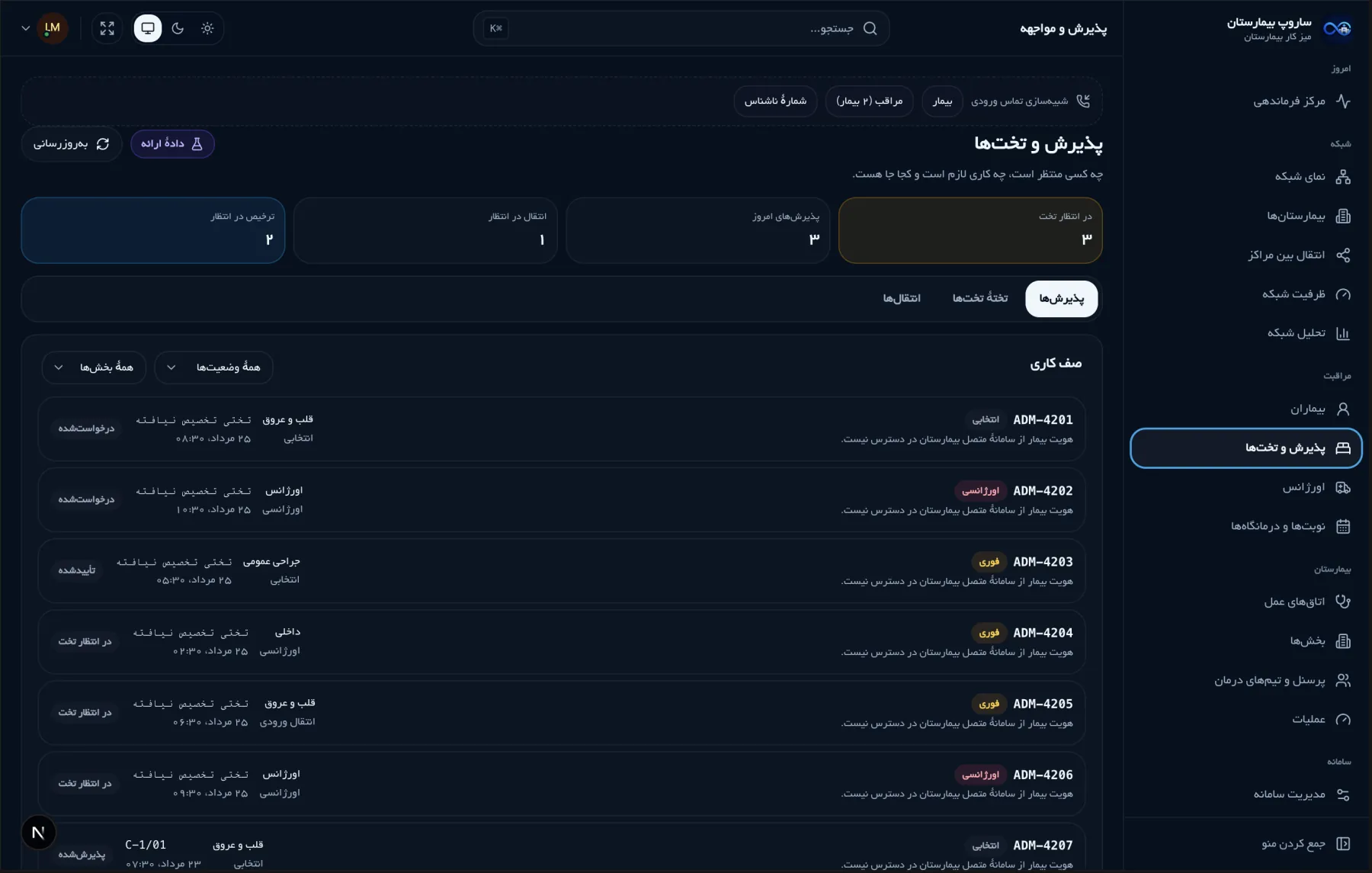
Verified product scope
The public story is intentionally narrower than the full product roadmap. These areas have current frontend surfaces and Go v2 service contracts, subject to deployment configuration and authorization.
Organization-scoped admission, transfer and discharge operations with encounter context.
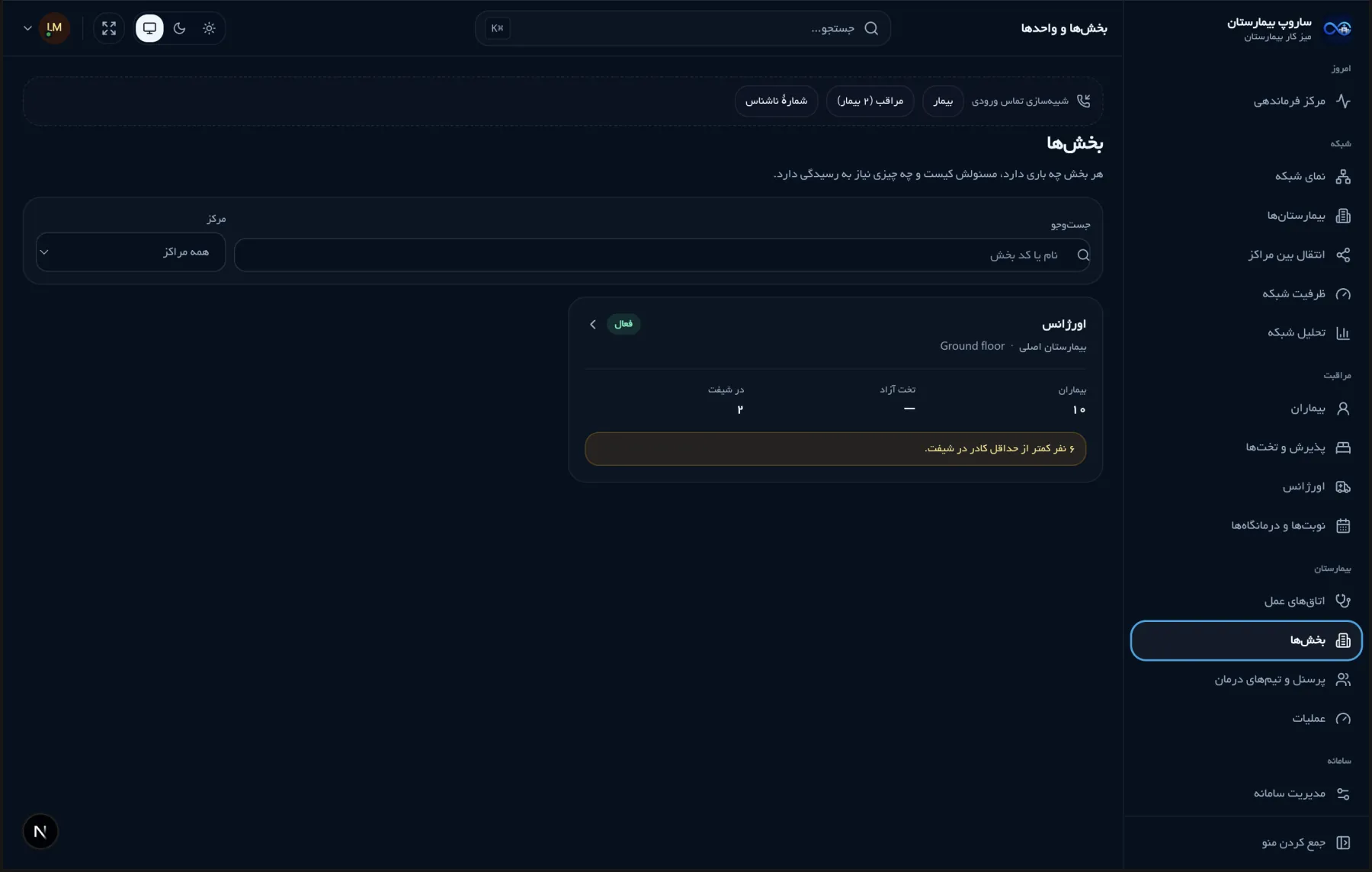
Contract-backedHospital profile, location, departments and aggregate capacity without pretending a missing bed inventory exists.
Contract-backedMembership context, professional verification posture, minimized audit events and operating-room scheduling.
Contract-backed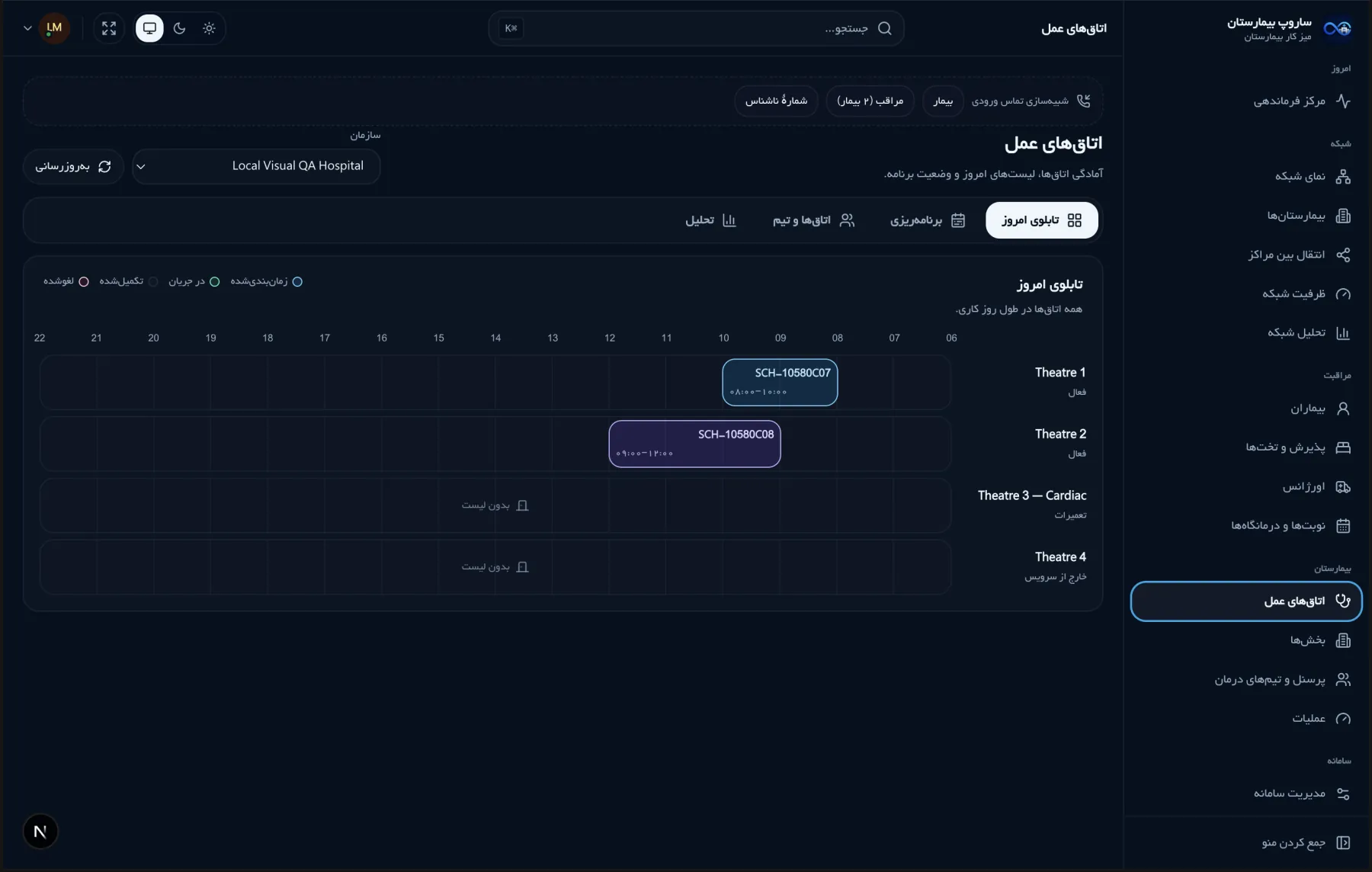
Discharge & continuity
A configured discharge workflow can establish the next responsible step and connect relevant follow-up across the Sarop ecosystem. Information remains purpose-limited, authorized and owned by the appropriate clinical or patient domain.
Discharge state and transition context.
Configured follow-up or questionnaire assignment.
The patient-facing side of authorized continuity.
Home or nursing workflow when configured.
Relevant follow-up returns to the authorized workflow.
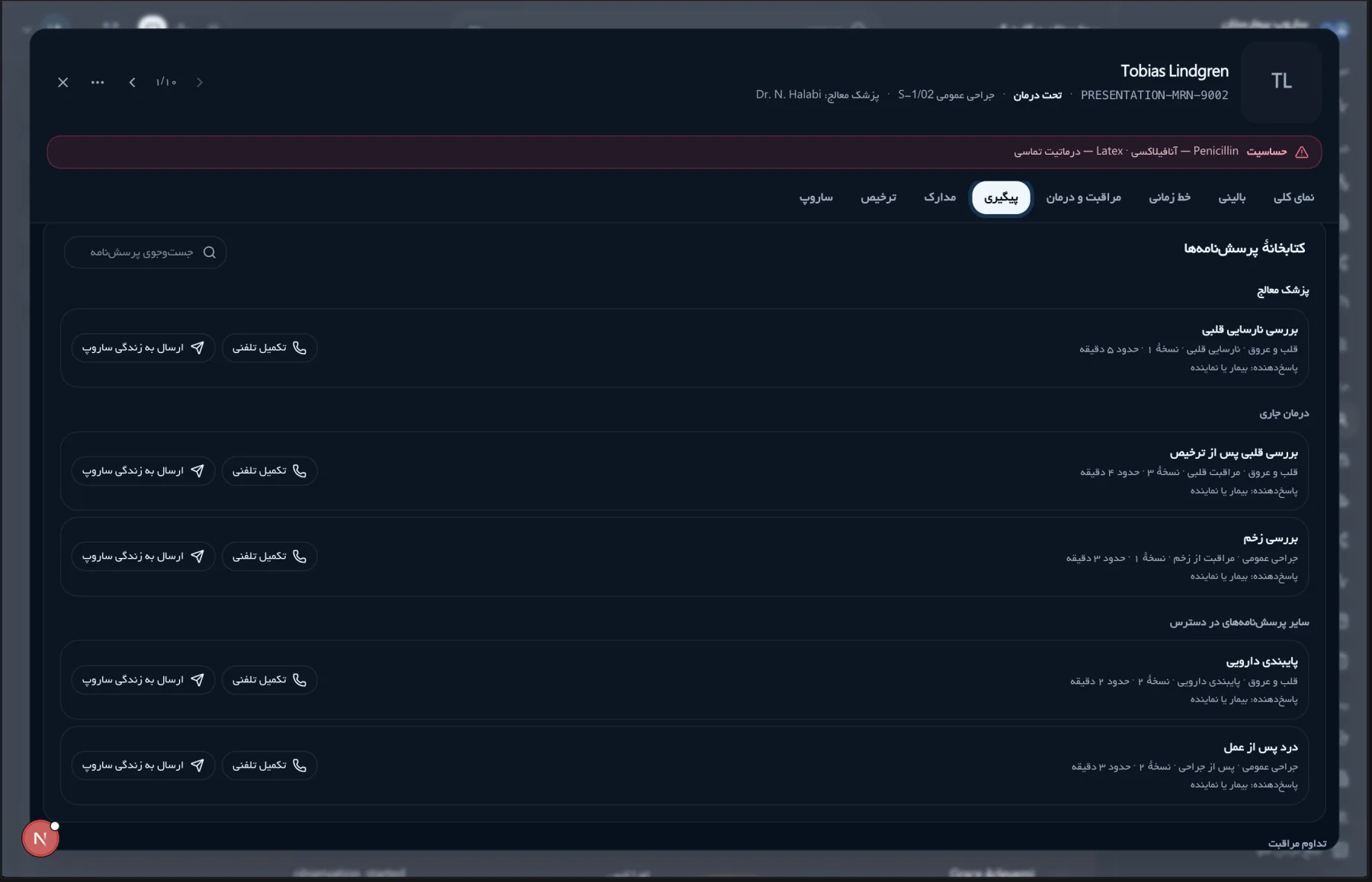
Close the post-discharge gap
Configured follow-up templates turn an informal intention into an assignable part of the journey. The interface below shows the Persian presentation environment; availability and clinical response rules depend on the agreed pilot workflow.
Integration & governance
Sarop Hospital is designed as a connected layer around existing systems, not a demand to replace the hospital’s entire environment. Access requires a valid session, an organization context and permission checks; clinical data remains minimum-necessary and purpose-scoped.
Requests are bound to the selected hospital organization rather than a universal workspace.
People see the context required for their responsibility, subject to backend authorization.
Specific interfaces and data ownership are validated during discovery; no “any HIS” promise.
Audit surfaces use controlled action, resource, scope and correlation context.
The wider Sarop ecosystem
Hospital sits alongside the products used by patients, clinicians and care teams. Connections represent configured workflows and authorized continuity — never “all data everywhere.”
Patient flow, facility operations and coordinated transitions.
Personal health continuity and patient participation.
Clinician workflows within appropriate professional scope.
Dental context where the care journey requires it.
Configured home and nursing continuity.
Sarop Enterprise may support organizational relationships where contractually appropriate; it is not presented here as a clinical record owner.
A controlled adoption path
A pilot begins with one clear operational pain. The current environment, accountable people, data ownership, integration boundaries and decision criteria are defined first. The next scope is considered only after that journey is verified.
The next step for hospital leadership
Choose one real journey—from admission to discharge or follow-up—and make the breaks in information, accountability and next action visible within that scope.